


Tired of being intimidated by terms like LoRA, QLoRA, DPO, PPO or GRPO?
Tired of endless tutorials that teach you just one of these topics—but never give you a complete, step-by-step roadmap?
Tired of too much math and not enough code? Or the opposite … tons of code with barely any explanation?
🎉 Don't worry, friend, we've got you covered … Today, Antonio Zarauz Moreno and I are officially starting our Finetuning Sessions!
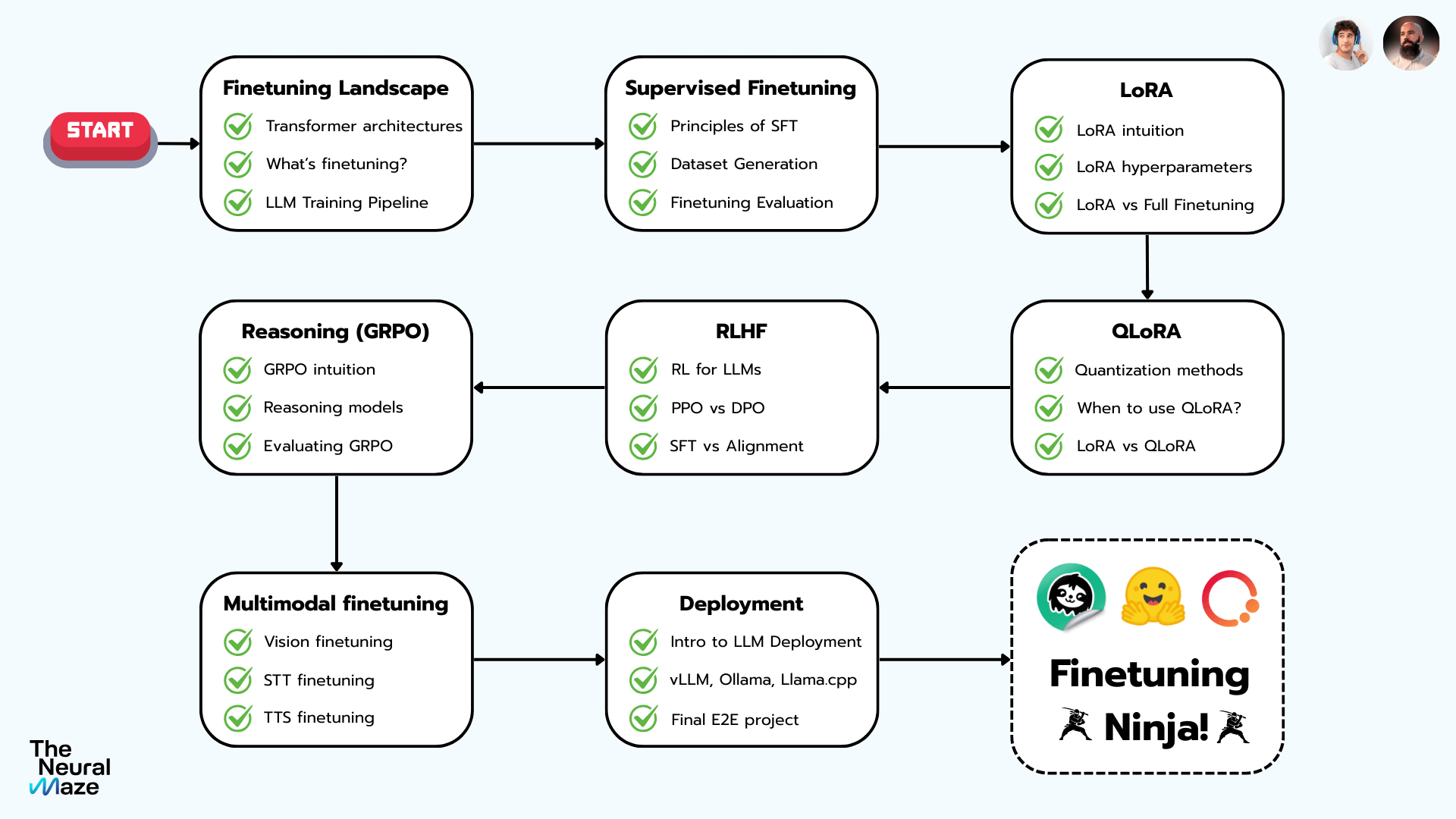
Together, we'll walk through everything you need to know, step by step — from "What the hell is finetuning?" all the way to actual LLM deployment. Along the way, we'll break down concepts like LoRA, QLoRA, RLHF, and more, without skipping the fundamentals or overwhelming you.
Since this is the first article in the series, we'll keep it intentionally light. Think of it as a map for the journey ahead.
Here, we'll lay out what the series is about: the lessons we'll cover, what each lesson includes, and the kind of content you can expect from each one.
So, if you're ready… let's go! 👇
Course Structure
This course is designed as a step-by-step journey into LLM finetuning. Each lesson builds on the previous one, gradually moving from first principles to practical concepts.
Rather than isolated tutorials, the lessons are structured to form a coherent roadmap—combining intuition, theory, and hands-on code—so you always understand why you're doing something, not just how.
Each lesson is divided into three types of content:
📘 Foundations Article → Conceptual grounding and mental models, with occasional lightweight code examples to illustrate key ideas.
🔬 Applied Lab Article → Hands-on, implementation-focused walkthroughs that put the foundations into practice through real workflows and use cases.
🎙️ Live Office Hours → Live sessions to review the articles, run the lab, and discuss decisions, and answer questions.
With that structure in mind, let's take a moment to clarify how each type of content is accessed.
📘 Foundations Article → Free · Released on Wednesdays
🔬 Applied Lab Article → Premium · Released on Fridays
🎙️ Live Office Hours → Premium · Live on Sundays
🙋 This weekly cadence is intentional: theory on Wednesday, practice on Friday, and discussion on Sunday, giving you space to learn, implement, and engage at each step!
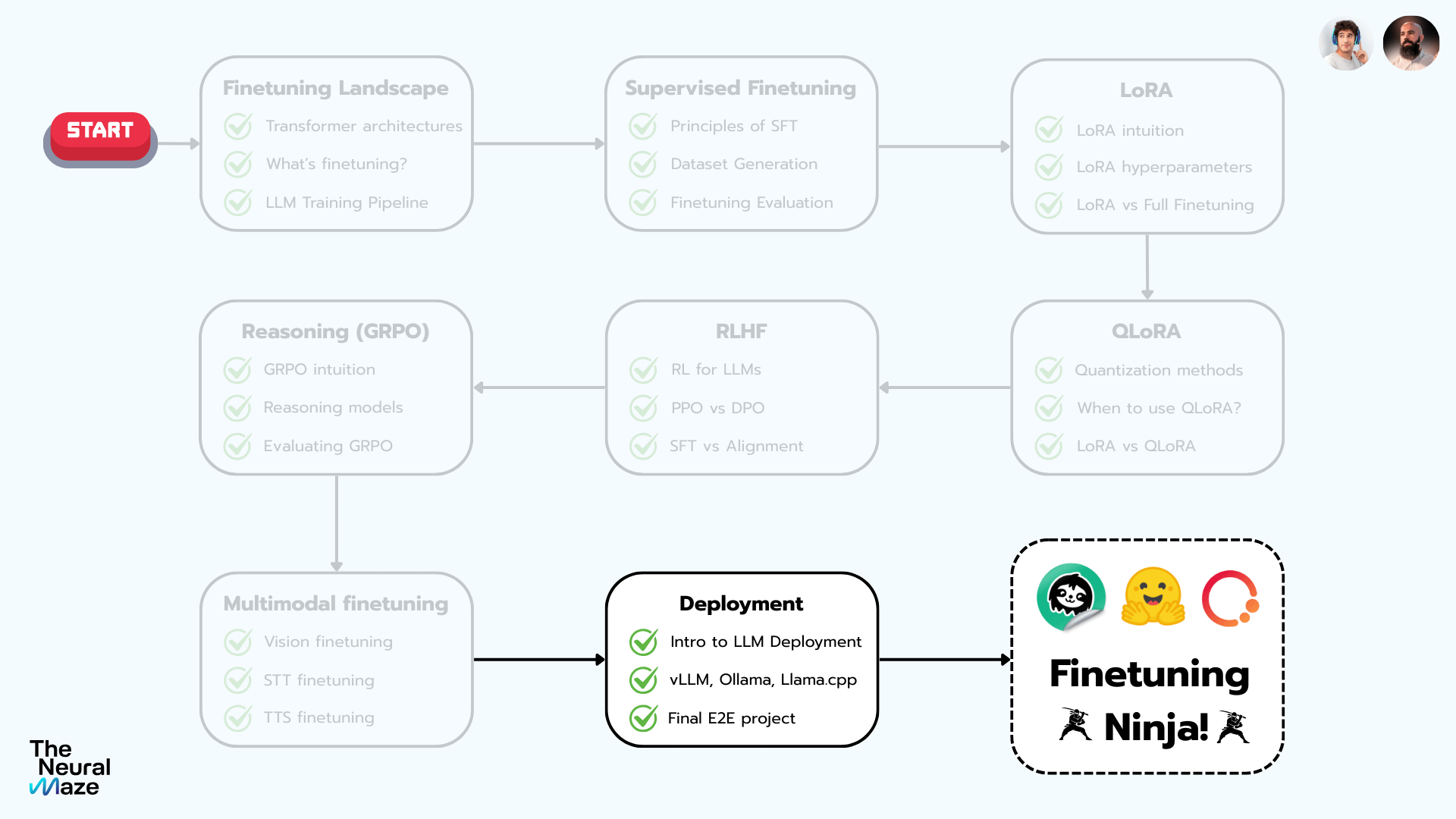
Below, we'll walk through the different lessons, what each one covers, and how they fit together.
Lesson 1 - Finetuning Landscape
📘 Article → February 11, 2026
🔬 Lab → February 13, 2026
🎙️ Office Hours → February 15, 2026
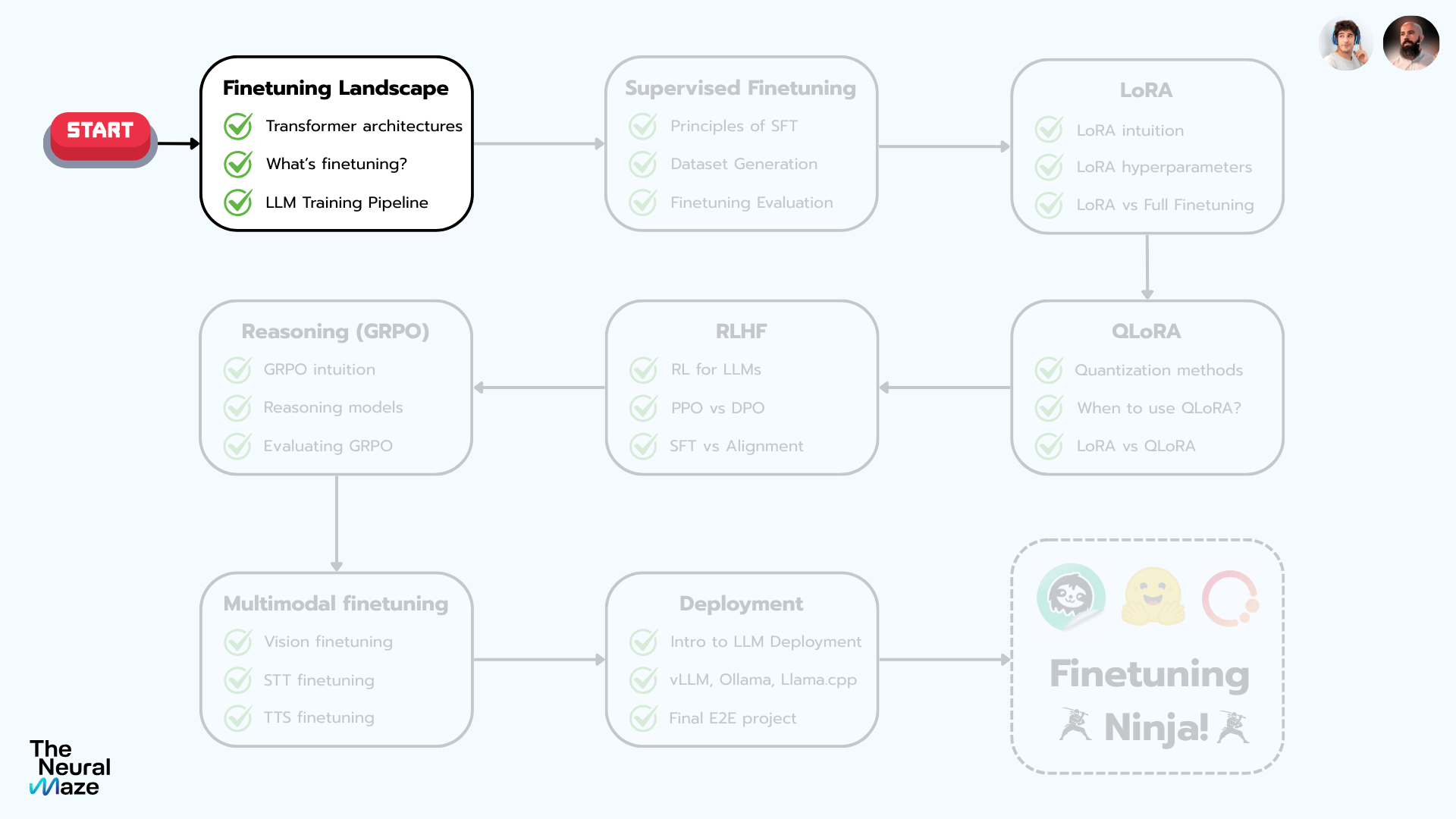
In this lesson, we build a high-level understanding of finetuning and where it fits in the modern LLM ecosystem.
We'll start by explaining why finetuning matters, comparing it to prompting and RAG, and exploring why it's becoming increasingly important as real-world use cases grow more demanding.
Finally, we'll introduce the LLM training pipeline—pretraining, supervised finetuning, and alignment—giving you the conceptual map you'll need to navigate the rest of the course.
Lesson 2 - Supervised Finetuning
📘 Article → February 18, 2026
🔬 Lab → February 20, 2026
🎙️ Office Hours → February 22, 2026
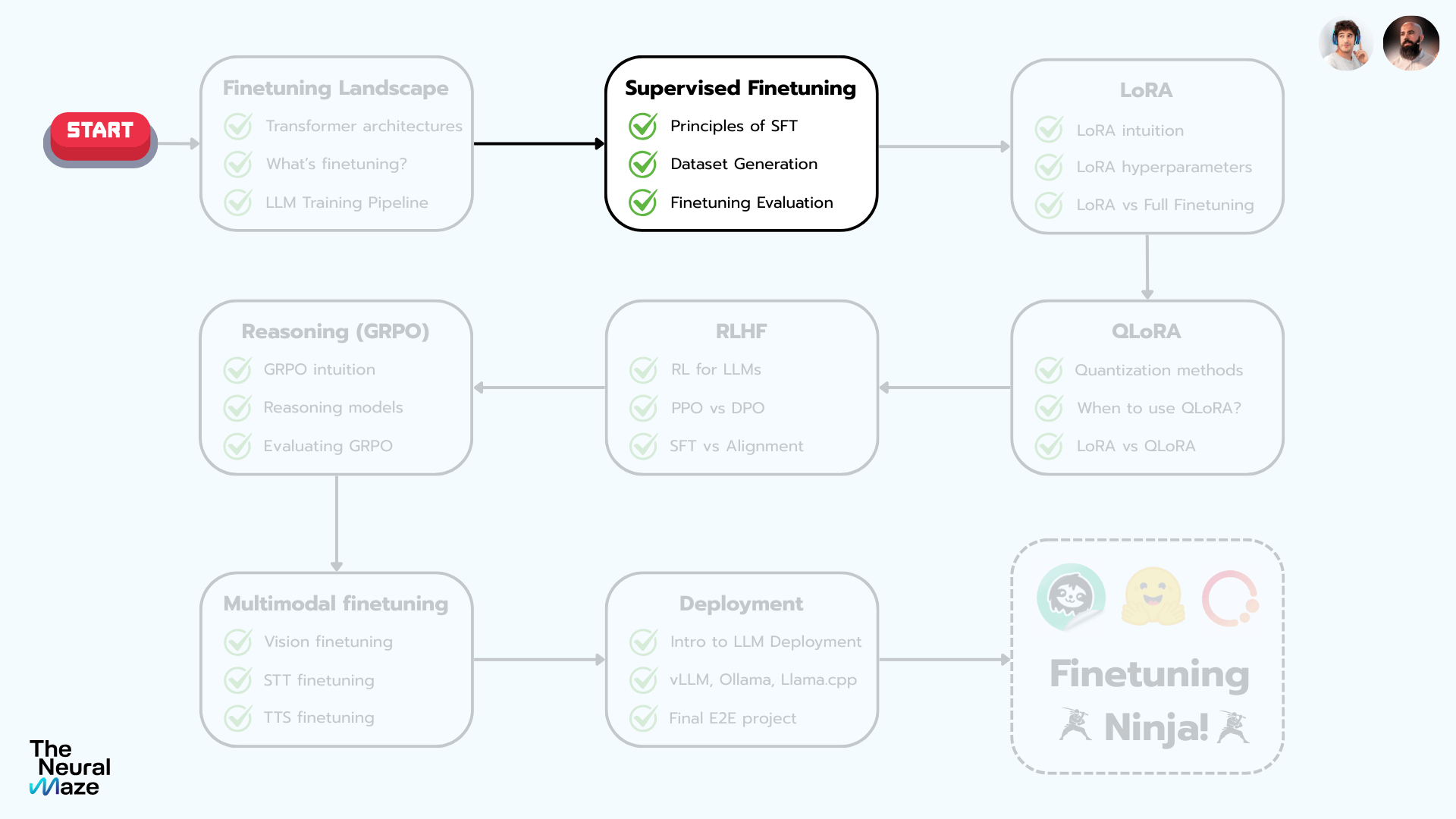
In this lesson, we focus on supervised finetuning (SFT) from end to end. We'll explain why SFT exists, introduce the modern finetuning stack, and cover dataset creation, instruction formats, and chat templates.
You'll learn when to finetune base models vs instruct models, how to evaluate finetuned models, and what to watch out for in practice.
Lesson 3 - LoRA
📘 Article → February 25, 2026
🔬 Lab → February 27, 2026
🎙️ Office Hours → March 1, 2026
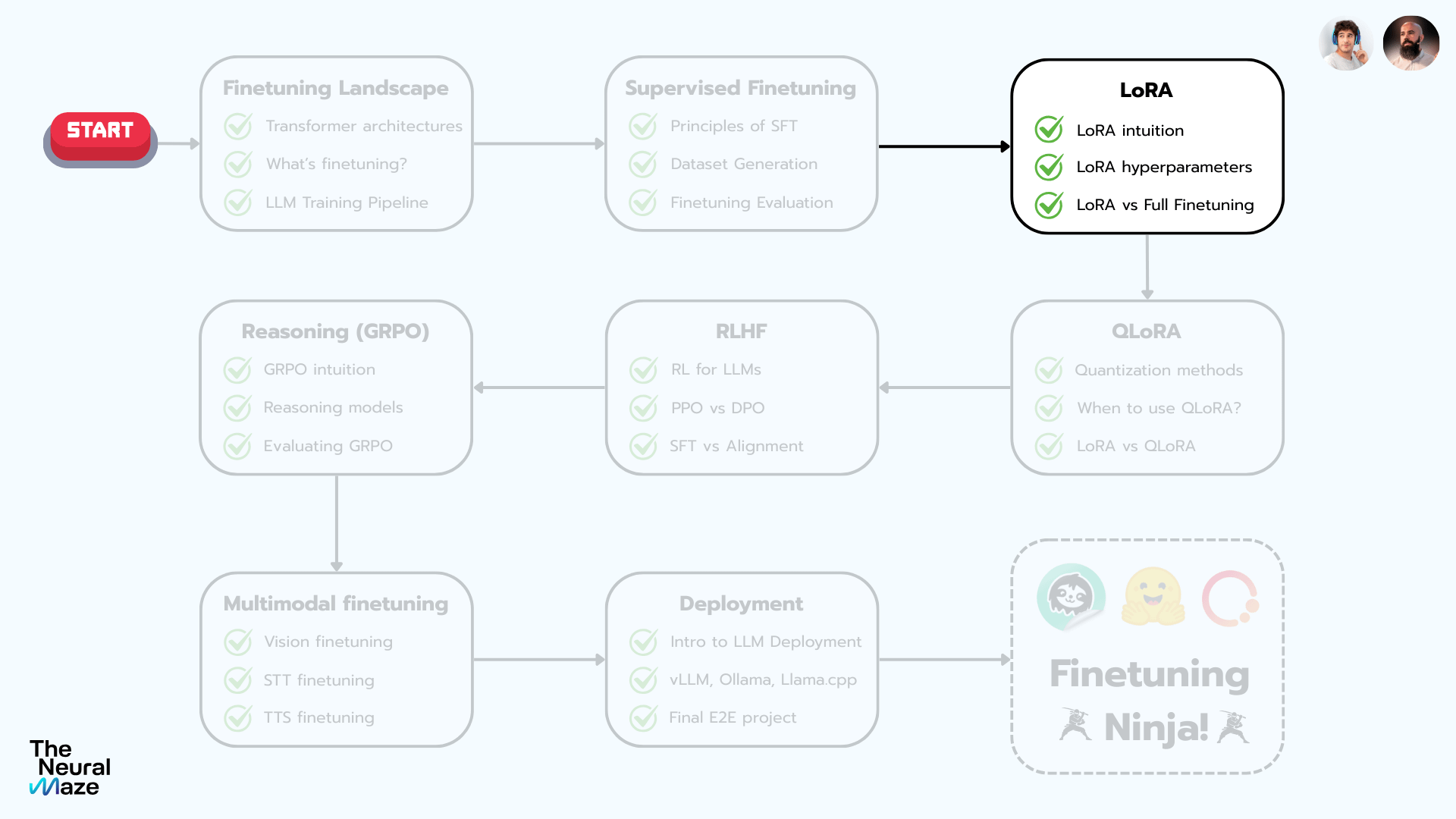
In this lesson, we introduce LoRA as a practical and efficient alternative to full finetuning. We'll start by explaining why full finetuning is often wasteful, then build intuition for LoRA through the low-rank hypothesis—without jumping into math too early.
We'll explore where LoRA fits inside the transformer architecture, which layers are typically adapted, and why attention projections are the usual focus.
Finally, we'll cover the LoRA hyperparameters that actually matter—such as rank, alpha, and target modules—and how changing them affects model behavior and performance.
This lesson gives you the conceptual foundation needed to use LoRA confidently in practice and to reason about its trade-offs.
Lesson 4 - QLoRA
📘 Article → March 4, 2026
🔬 Lab → March 6, 2026
🎙️ Office Hours → March 8, 2026
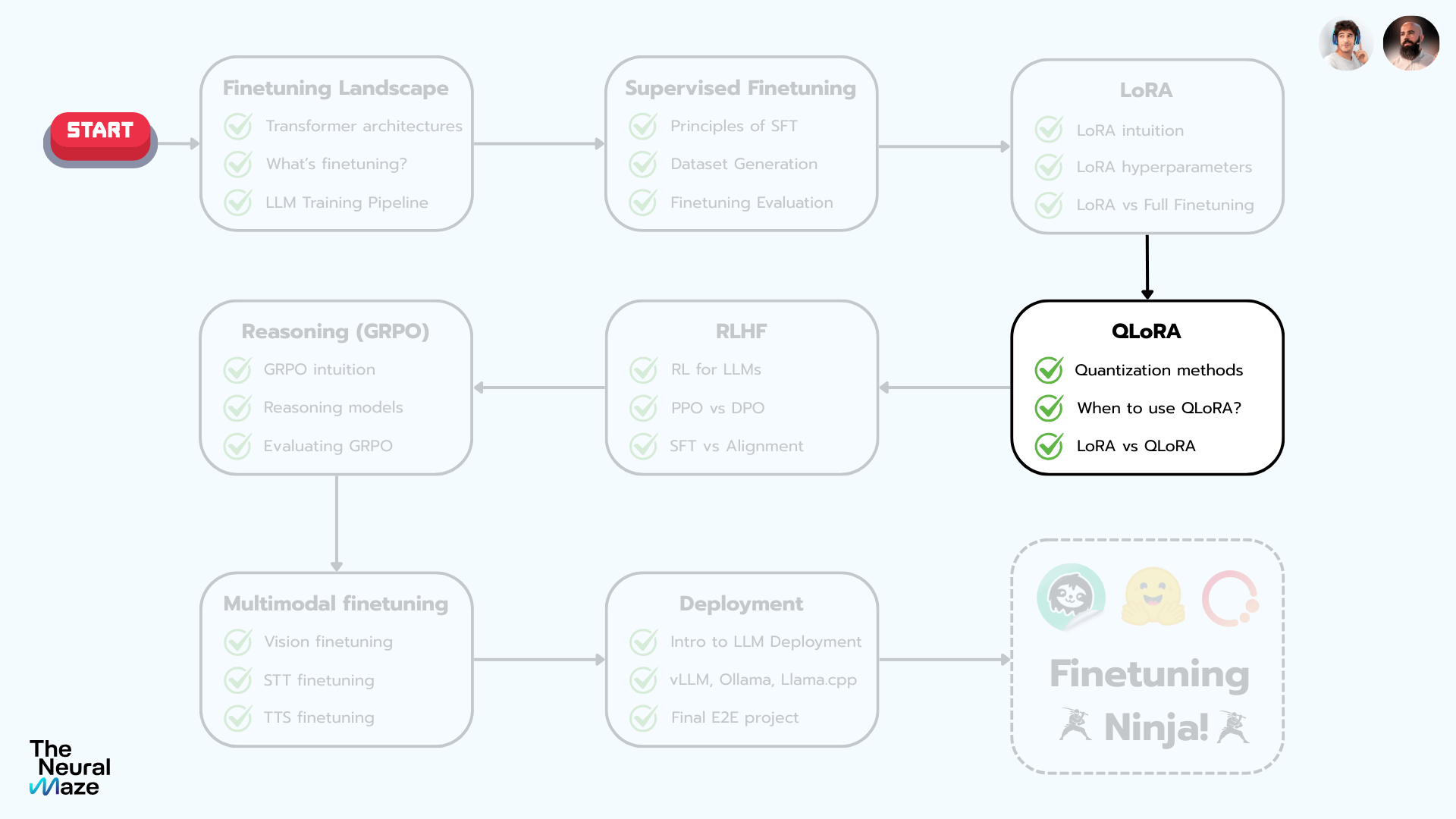
In this lesson, we dive into QLoRA and explain how it extends LoRA to make finetuning large models feasible on limited hardware. We'll start by clarifying the differences between LoRA and QLoRA, and why quantization becomes necessary as model sizes grow.
We'll then refresh the key ideas behind quantization and walk through the QLoRA stack at a conceptual level—how a 4-bit quantized base model works together with higher-precision LoRA adapters.
Finally, we'll discuss practical decision rules for when QLoRA is the right choice.
By the end of this lesson, you'll understand not just how QLoRA works, but when and why to use it.
Lesson 5 - RLHF
📘 Article → March 11, 2026
🔬 Lab → March 13, 2026
🎙️ Office Hours → March 15, 2026
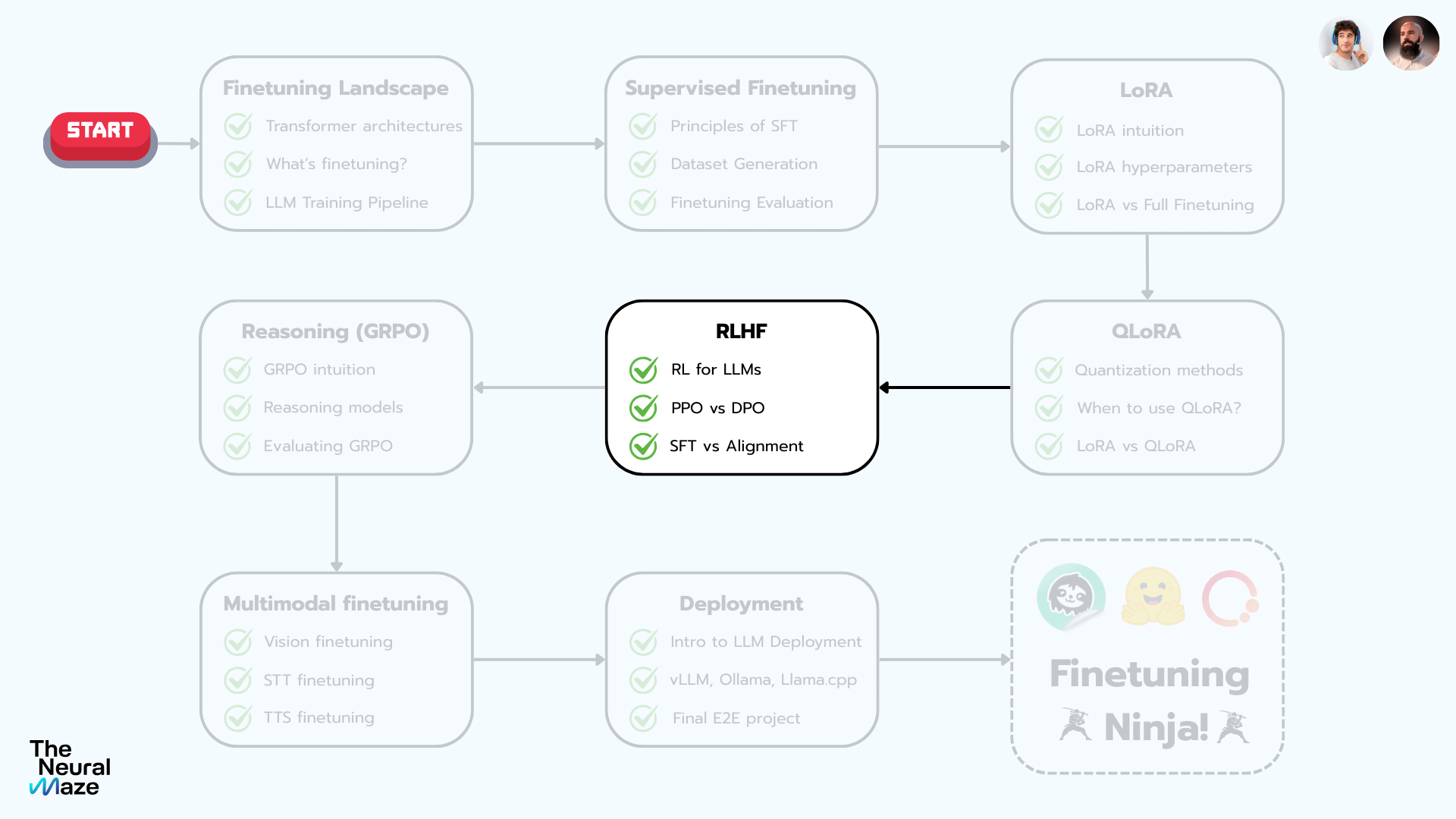
In this lesson, we move beyond supervised finetuning and explore alignment—why SFT alone is sometimes not enough and what alignment means in practice.
We'll introduce RLHF from a high-level perspective, covering the core ideas behind reinforcement learning and the key components involved. From there, we'll break down the two most common alignment approaches used today: PPO and DPO.
Finally, we'll compare DPO and PPO, discuss when each approach makes sense, and briefly touch on alternative alignment methods. By the end of this lesson, you'll have a clear mental model of how alignment fits into the LLM training pipeline and why it matters.
Lesson 6 - GRPO
📘 Article → March 18, 2026
🔬 Lab → March 20, 2026
🎙️ Office Hours → March 22, 2026
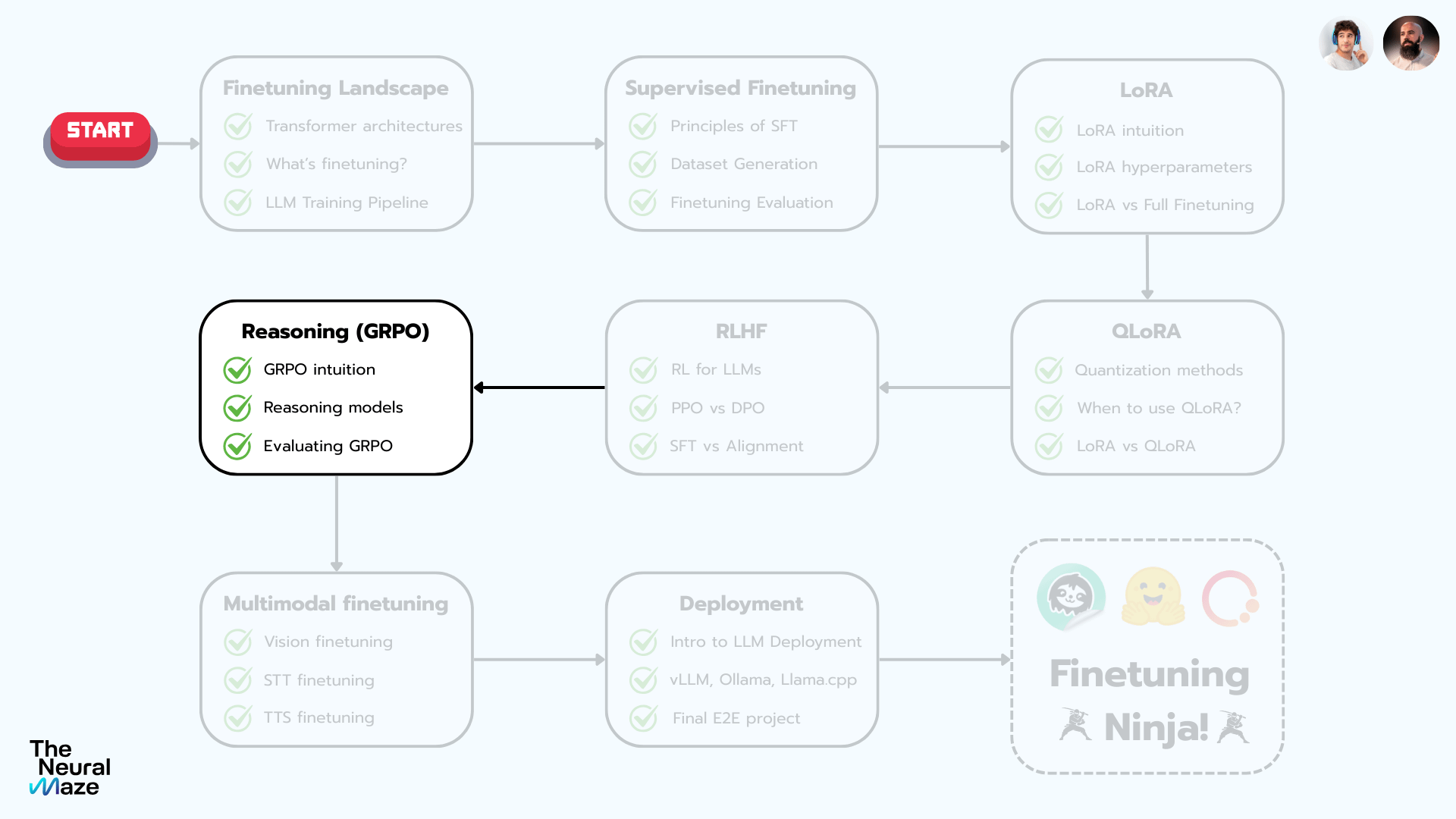
In this lesson, we focus entirely on GRPO, given its growing impact on modern LLM training. We'll start by building intuition for GRPO and explaining how it differs from approaches like PPO and DPO, referencing key ideas from recent research where relevant.
We'll then introduce reasoning models, exploring how they work, the role of specialized reasoning tokens, and why these models require different training strategies.
By the end of this lesson, you'll understand what makes GRPO unique, when it should be used, and how it fits into the broader alignment and reasoning landscape.
Lesson 7 - Multimodal Finetuning
📘 Article → March 25, 2026
🔬 Lab → March 27, 2026
🎙️ Office Hours → March 29, 2026
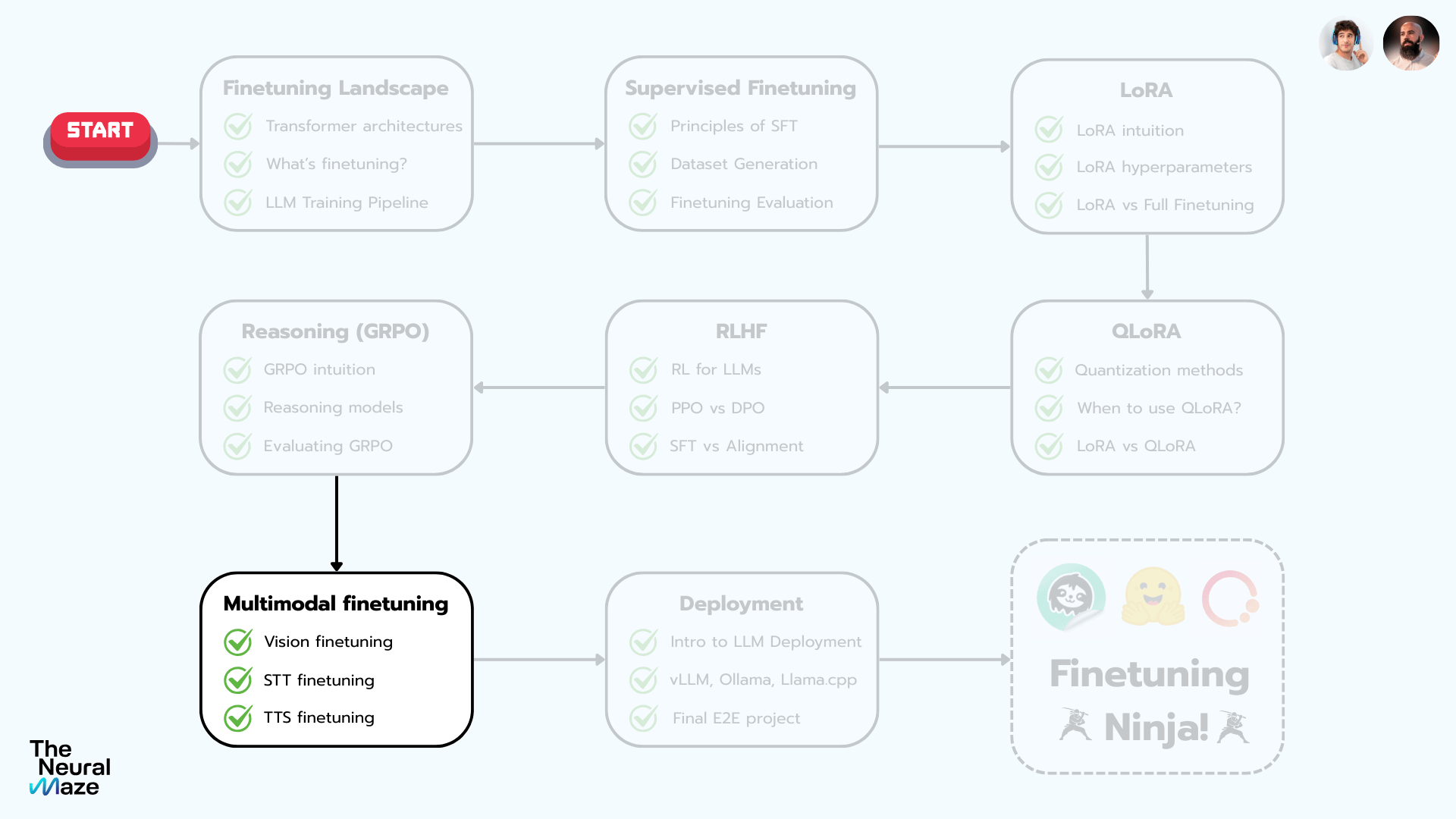
In this lesson, we go beyond language models and explore multimodal finetuning. We'll introduce how finetuning extends to other modalities, focusing on speech and vision.
We'll cover the fundamentals of speech-to-text (STT) and text-to-speech (TTS) finetuning, as well as the core ideas behind vision model finetuning. The goal is to build intuition for how these modalities differ from text-only models, and what new challenges they introduce.
By the end of this lesson, you'll have a clear picture of how finetuning applies beyond text and how these approaches fit into real-world multimodal systems.
Lesson 8 - LLM Deployment
📘 Article → April 1, 2026
🔬 Lab → April 3, 2026
🎙️ Office Hours → April 5, 2026
In this final lesson, we focus on deployment—how to take finetuned models out of notebooks and into real-world applications.
We'll explore practical deployment options for different scenarios, including running models locally with tools like llama.cpp and Ollama, deploying models on constrained hardware, and serving models at scale in private cloud environments using vLLM.
The goal of this lesson is to help you understand the trade-offs between different deployment strategies and to give you a clear picture of what viable, real-world LLM deployment actually looks like today.
Next Steps
To get started, there are just two things to keep in mind:
This Friday (February 6, 2026), we'll send you the first lab. It will introduce the libraries and frameworks we'll be using, along with an overview of the tech stack. You can think of it as a "Lesson 0" lab, focused on providing context around the tools and infrastructure we'll be using.
Next Sunday (February 8, 2026), we'll host a welcome office hours session where you can ask questions and clear up any doubts.
⚠️ The upcoming lab session and office hour will be available to all subscribers (free and paid). After that, all future office hours and labs will be exclusive to premium subscribers.
That's all for today! Well… not exactly.
How excited are you about the upcoming Finetuning Sessions? 😝
See you this Friday, builders! 👋
It's interesting how perfectly you've captured the current frustration with scattered learning materials on finetuning; this structured, step-by-step roadmap sounds like a real lifesaver for anyone diving into LLM deployment. I especially appreciate the promise of balancing intuition with code, because honestly, after sifting through countless LoRA guides that either felt like a PhD thesis or just gave me a `pip install` command, a comprehensive aproach is a breath of fresh air.
Can't wait! all the essential topics will be covered here :)