


Hey friends! 👋
We are officially wrapping up Grokking Agents in Production, the cohort-based course we've been running alongside the incredible Luis Serrano . We are absolutely thrilled to say that over 160 engineers joined us for this run. When we set out to build this, our goal was simple: ignore the high-level slides and build real, production-ready agent architectures.
Judging by the feedback, the live coding sessions, and the late-night debugging in our channels, we clearly overdelivered … and we couldn't be happier about how it turned out! 😍
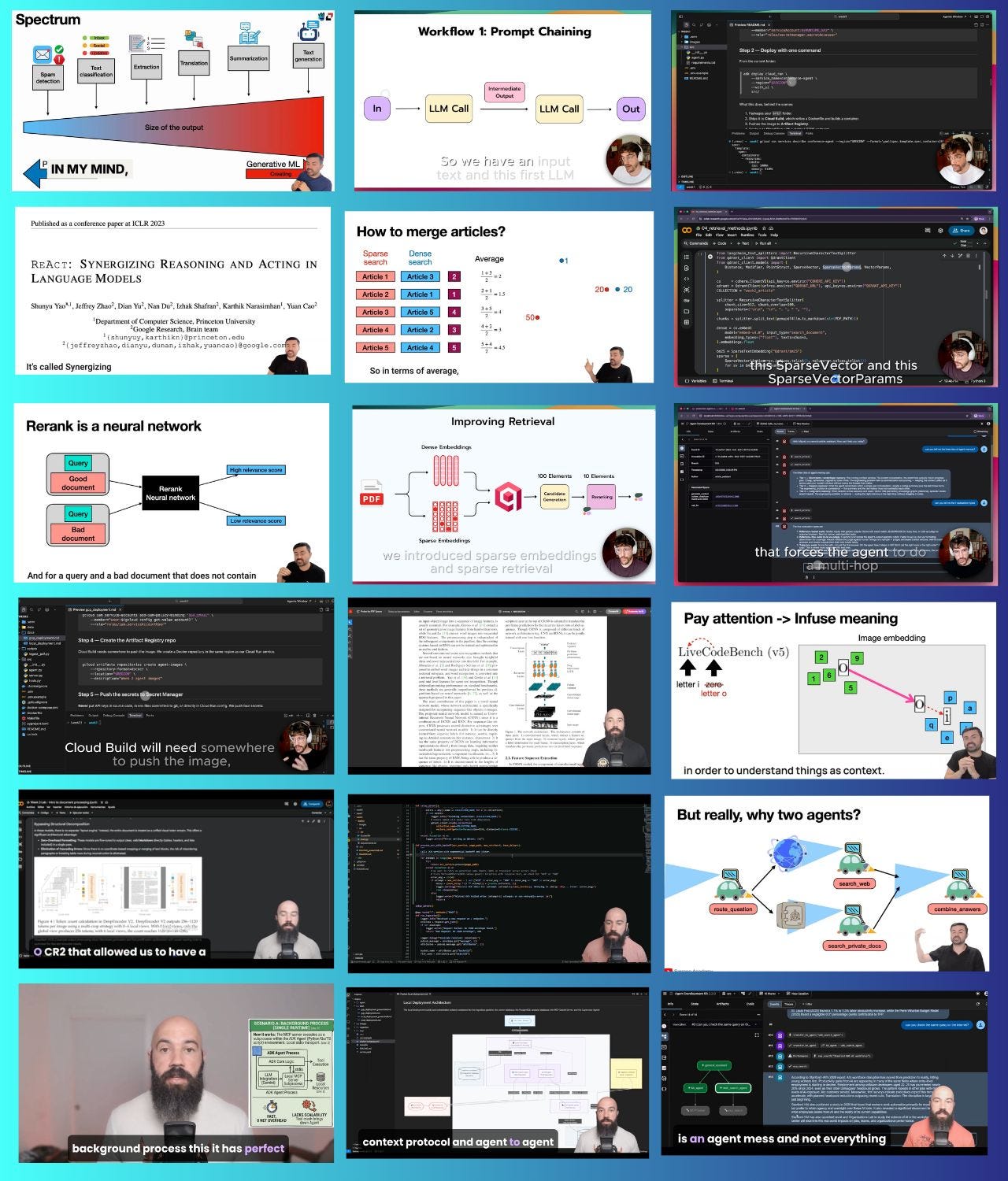
To everyone who spent their weekends tracing agent trajectories with us:
THANK YOU!
You are the reason we build this. But, you know The Neural Maze philosophy …
WE ARE NOT SLOWING DOWN!
If there is one thing we heard loud and clear from our chats with you during the course, it's that document intelligence is a massive, unsolved headache.
An agent is only as good as the context it consumes. Feed it flat, garbled text from a legacy OCR engine, and the smartest model in the world turns into a fumbling beginner.
Modern document intelligence isn't about extracting plain characters anymore; it's about Visual Document Understanding (VDU). It's about feeding an agent structured tables, high-density charts, complex mathematical formulas, and spacial layouts without losing the semantic relationships between them.
But serving these multimodal models at scale is a resource-management nightmare.
Vision-language models (VLMs) have a massive prefill stage that hogs GPU memory, while the subsequent decoding stage is starved for memory bandwidth. Colocating them on the same hardware is a recipe for high latency and massive cloud bills.
So, we did what we always do …
We built a production-grade blueprint to solve it 😎
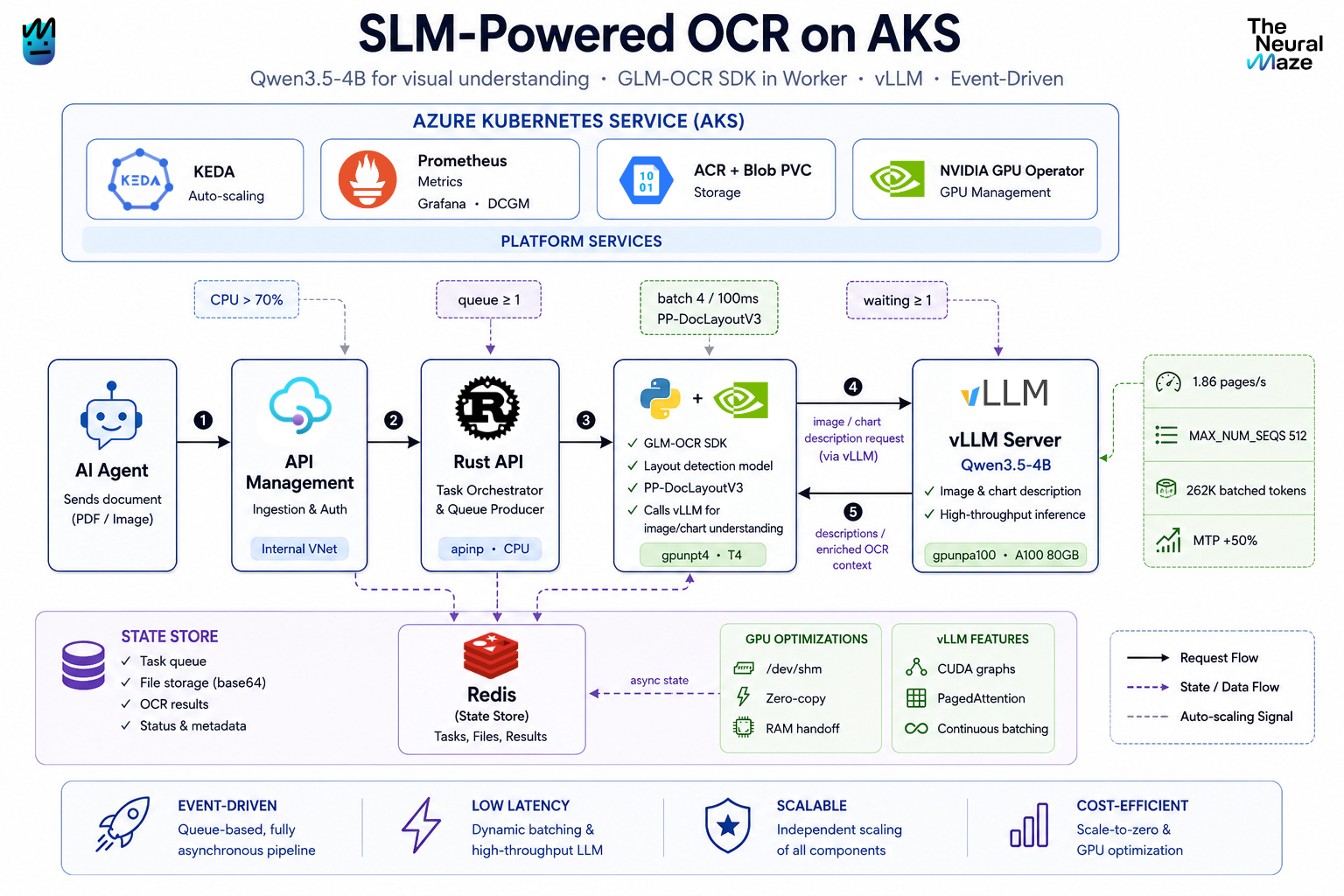
We've built a fully decoupled, event-driven OCR pipeline designed for Kubernetes.
It utilizes an Autonomous Worker Architecture combined with a centralized, decoupled inference engine to achieve high throughput and scale-to-zero cost efficiency.
We're breaking this repo down into a series of deep-dive articles and hands-on office hours. These are the core ideas we'll explore, one step at a time:
The Kubernetes Mental Model: We'll start with a primer on cluster orchestration. If you've never touched K8s, don't sweat it. We'll cover the fundamental concepts of scheduling, node pools, and GPU drivers before we write a single line of YAML.
Decoupled Model Serving: We will deploy visual language models using high-performance engines like vLLM, tuning parameters specifically to prevent prefill bottlenecks on premium GPU nodes.
Securing the Gateway: We'll build and expose the gateway layer using load balancers and enterprise-grade API management to rate-limit requests and protect expensive GPU pools from traffic spikes.
High-Concurrency Pipelines: We'll explore why traditional web frameworks struggle with binary file uploads and how systems languages like Rust, paired with asynchronous queues, make ingestion lightning-fast.
Asymmetric Hardware Scaling: We'll deploy lightweight workers on cheap GPU pools (like T4s) to extract layout structures, while funneling heavy text generation tasks to premium GPU nodes (like A100s).
Zero-Copy Ingestion: We'll dive into low-level systems tricks, bypassing slow disk I/O entirely by using Linux shared memory (/dev/shm) to hand off high-resolution document buffers.
Scaling to Zero: Finally, we'll implement event-driven autoscaling. When the queue is empty, the cluster spins down the GPUs to zero. When a file hits the API, the nodes spin up instantly.
No PowerPoint slides, no hand-wavy architecture diagrams. Just clean code, real metrics, and production YAML configurations.
How to access this content?
This series isn't a collection of high-level case studies. It's an interactive, engineering-heavy program built for Premium Subscribers.
Here is how we're running the stack week-by-week:
Production Article per week: Every Wednesday, you'll get a deep-dive post covering the systems math, configuration choices, and architectural trade-offs.
The Complete Production Codebase: No placeholders, no skipped steps. You get full access to the deployable repository containing the Rust API gateway, Python workers, and Kubernetes manifests.
Weekly Live Office Hours: Every Sunday, we'll run a live hands-on session. We'll spin up the cluster, trigger scaling events, debug common pipeline failures, and answer your implementation questions live.
If you've been looking for a reason to transition from writing prompting scripts to building low-latency, multi-GPU infrastructure, this is it.
The AI Bros are back, folks … and this time, they've brought GPUs.
This is loaded! Looking forward to it!
Hi Miguel. Can you please tell us the date when we will be able to access the course content as a premium member.