


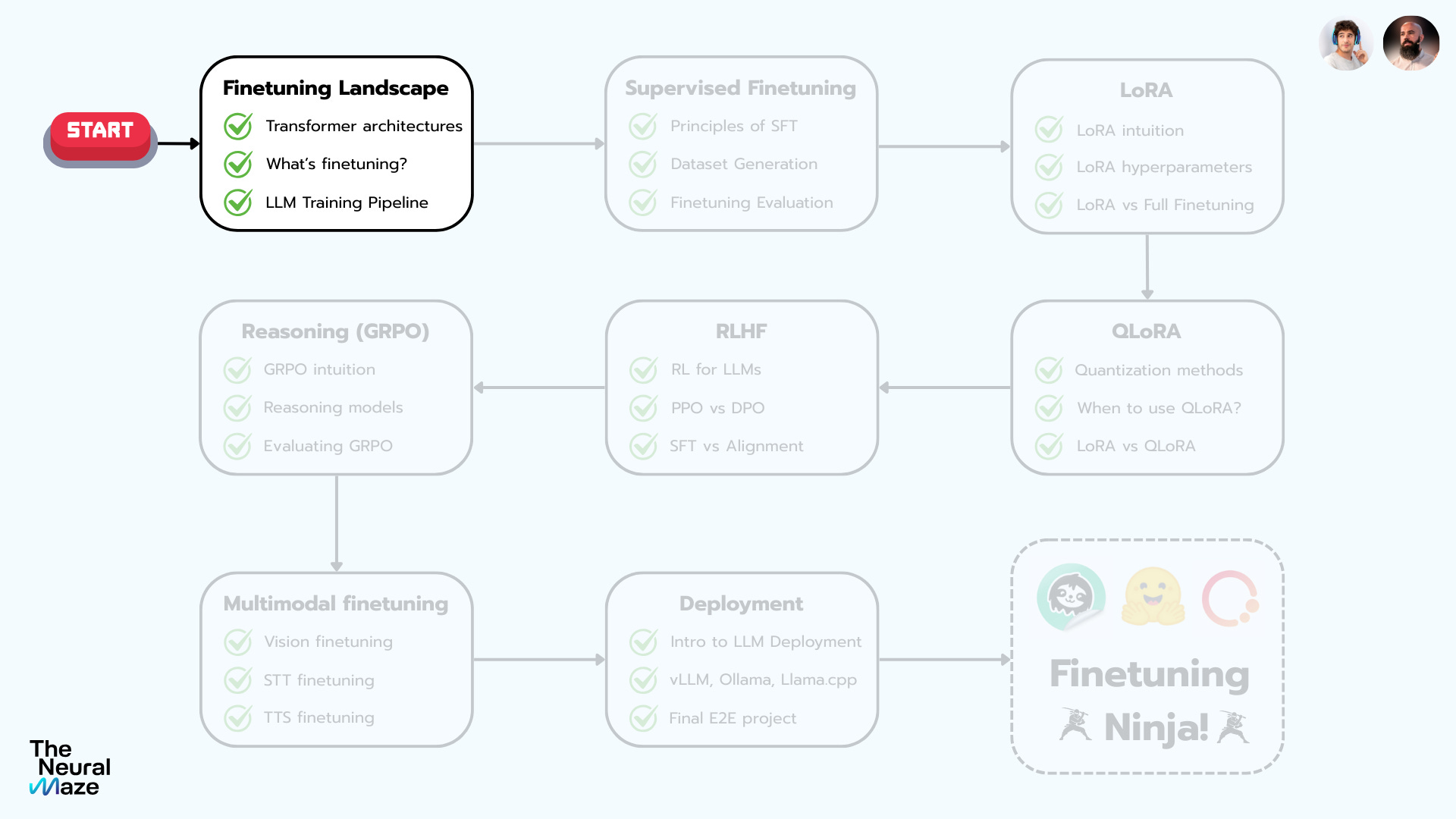
Welcome to Lesson 1 of the Finetuning Sessions!
🙋 Here's a small plot twist: for this first lesson, we're not talking about finetuning!
Before jumping into techniques like SFT or LoRA, it's important to understand what happens before finetuning ever starts. That's exactly what this lesson is about.
We'll break down what pretraining really means, introduce the Transformer architecture that modern LLMs are built on, and explain the key differences between encoder-only, encoder–decoder, and decoder-only models.
Along the way, you'll build a clear mental map of the training pipeline of modern language models, from pretraining to alignment.
✅ This context will pay off later.
Many advanced techniques—e.g. LoRA—only truly make sense once you understand how Transformers work under the hood.
So, think of this lesson as setting the foundation. Once that's in place, everything that follows will click into place much faster.
Transformer 101

At this point, you've probably heard the word Transformer so many times that it feels almost synonymous with "modern AI."
And in practice, that's not far from the truth: today, nearly every state-of-the-art language model is built on top of the Transformer architecture.
🙋 But here's a small surprise to kick things off: attention was not invented in the Transformer paper!
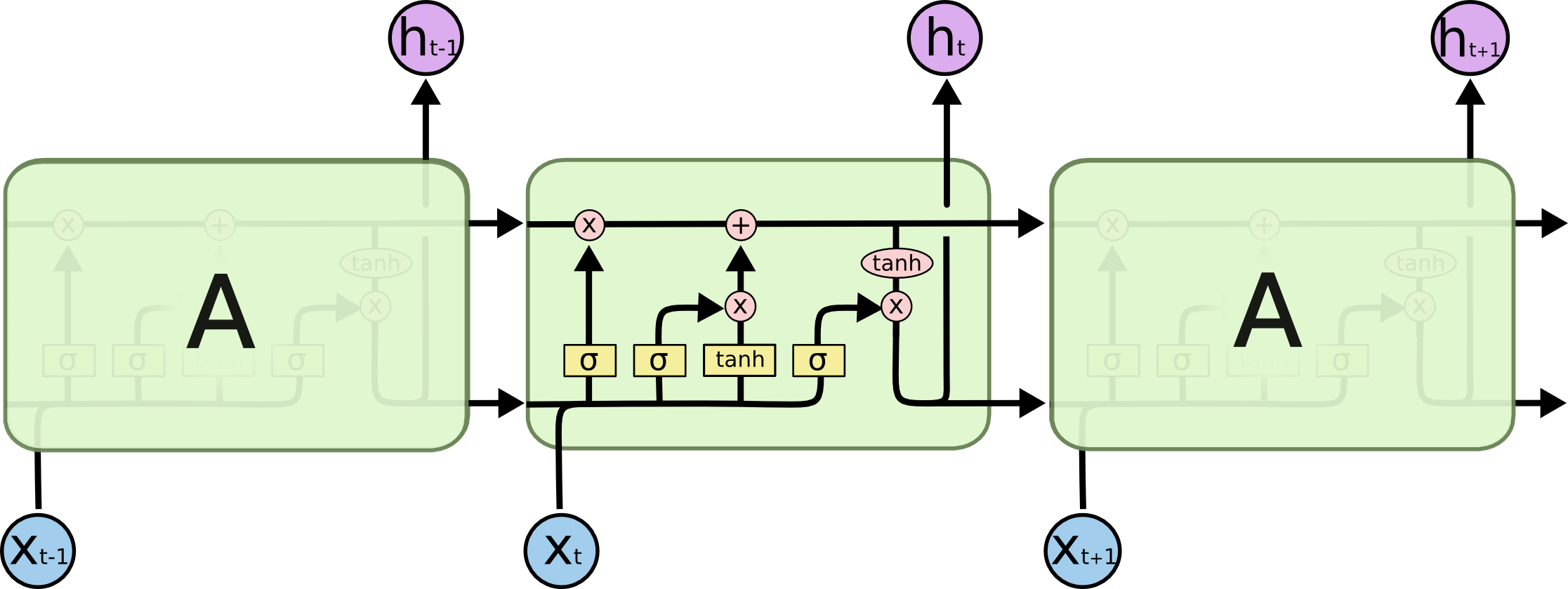
Long before Transformers took over natural language processing, deep learning was already going through its first major boom. Architectures like convolutional neural networks (CNNs) dominated vision, while recurrent neural networks (RNNs)—especially LSTMs—were the workhorse of sequence modeling tasks such as machine translation, speech recognition, and text generation.
These models worked, but they came with clear limitations, especially when dealing with long sequences and long-range dependencies.
✅ This is where attention mechanisms first entered the picture.
The Attention Mechanism
Originally introduced as an improvement to encoder–decoder recurrent models for sequence-to-sequence tasks (like machine translation), attention was designed to solve a simple but fundamental problem: instead of compressing an entire input sequence into a single fixed-length vector (state), why not allow the model to look back at different parts of the input as needed?

At its simplest, attention is a weighted lookup mechanism.
You start with:
A set of keys: k1, k2, …, kn.
A corresponding set of values: v1, v2, …, vn.
A query that expresses what you're looking for.
The attention mechanism compared the query against all keys, assigns a weight to each one, and then produces a weighted sum of the values. This operation is often called attention pooling.
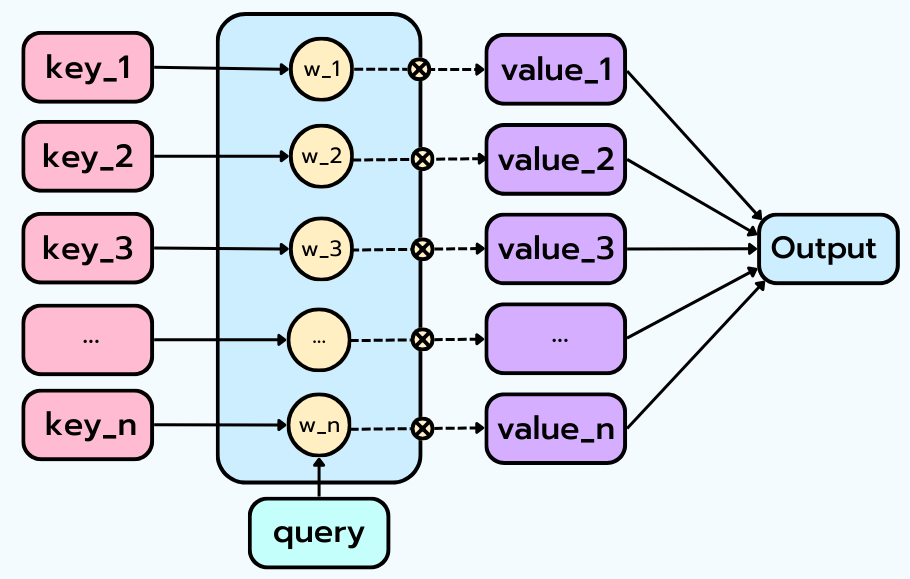
In other words:
🙋 Attention decides which pieces of information matter most, and combines them accordingly.
Early encoder–decoder models had to squeeze an entire input sentence into one vector before decoding. Attention removed this constraint by allowing the decoder to dynamically access all encoder states at every step. Longer sentences, richer context, better translations.
And this is where things get interesting … because at first, attention, was "just" an add-on! These mechanisms were trying to improve the encoder-decoder architecture in very specific applications.
But the implications, dear builders, ran much deeper …
Once you realise that this architecture can:
Query a set of representations
Select relevant information dynamically
Do so in a differentiable and parallelizable way
You no longer need recurrence at all!
🙋 This insight would end up reshaping neural network architectures across every domain.
Preparing the Ground for Transformers
So, as we already know by now, attention was not invented for Transformers, but one thing it's true. It radically expanded what attention mechanisms could do.
Several key evolutions turn basic attention pooling into the architecture that domains every domain nowadays.
Self-Attention
So far, attention has helped models look back at an input sequence when generating outputs, as in encoder–decoder models for machine translation.
✅ Self-attention takes this idea one step further.
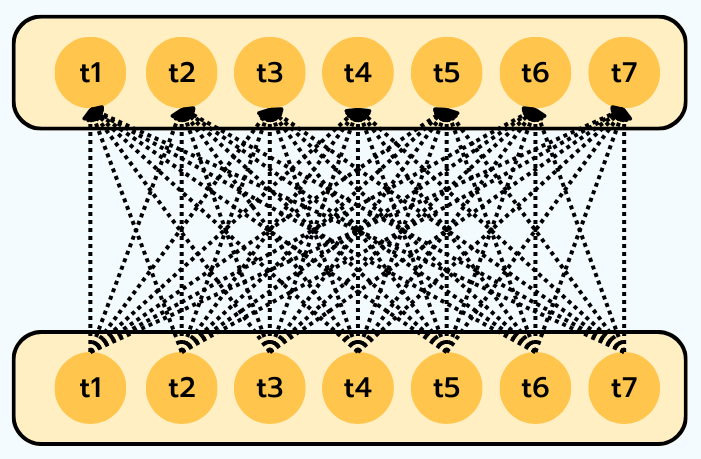
Instead of having one sequence attend to another, each token in a sequence attends to all the other tokens in the same sequence! Simple and genius at the same time.
Imagine you feed a sequence of tokens into a model:
The cat sat on the matIn self-attention:
Every token is turned into a query (Q), a key (K), and a value (V)
For each token, its query is compared with the keys of all tokens (including itself)
These comparisons determine how much attention the token pays to every other token
The token's new representation is built as a weighted sum of all values
So when the model updates the representation of "sat", it can:
Strongly attend to "cat" (who is sitting)
Attend to "mat" (where the action happens)
Largely ignore function words like "the"
Clear, right? Let's move on to another key technique: positional encodings.
Positional Encoding
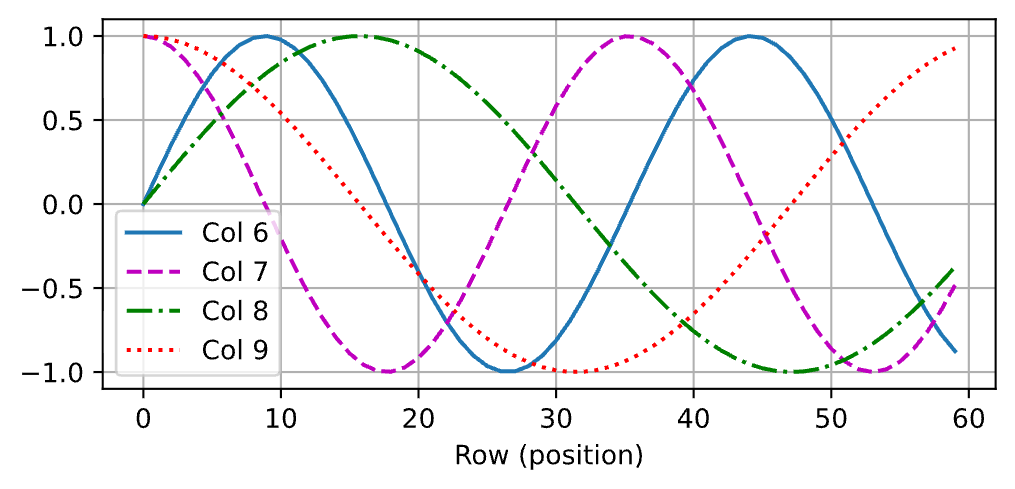
Attention itself has no notion of order. To make sequences meaningful, positional information is injected into token representations, allowing the model to distinguish "first", "next", and "last" without relying on recurrence.
In the original Transformer, positional encodings are built using sine and cosine functions at different frequencies.
Each dimension of the positional encoding corresponds to a sinusoid:
Low-frequency sinusoids capture coarse position information
High-frequency sinusoids capture fine-grained differences
Together, they form a rich representation of position.
🙋 A quick reassurance before moving on: don't worry if the exact intuition behind sinusoidal positional encodings doesn't fully click right now. We're mentioning them because they were an important design choice in the original Transformer architecture, and it’s useful to know why they exist.
Multi-Head Attention
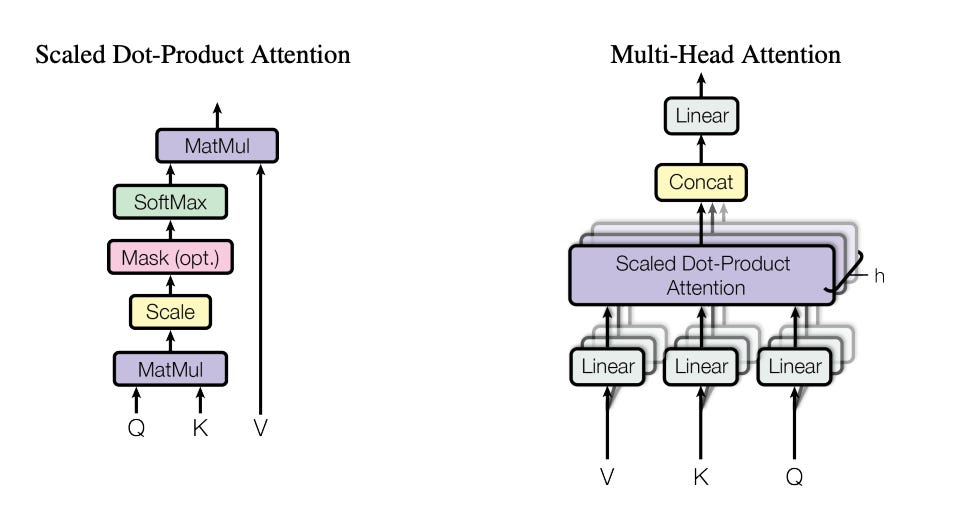
So far, we've talked about attention as a general idea: queries (Q) interact with keys (K) to decide how values (V) should be combined.
Scaled dot-product attention is the specific, concrete way the Transformer implements this idea.
At a high level, it works like this:
Each token produces a query, key, and value
Queries are compared with keys using a dot product
The resulting scores are normalized with a softmax
These normalized scores are used to compute a weighted sum of the values
This is the mathematical formula, in case you are interested:
With a single attention head, the model is forced to average all relationships into one view.
Multi-head attention removes this constraint.
Different heads can specialize in different patterns, such as:
Short-range vs long-range dependencies
Syntactic relationships
Semantic similarity
This allows the model to jointly attend to information from different representation subspaces, all at once.
Bringing It All Together: The Transformer
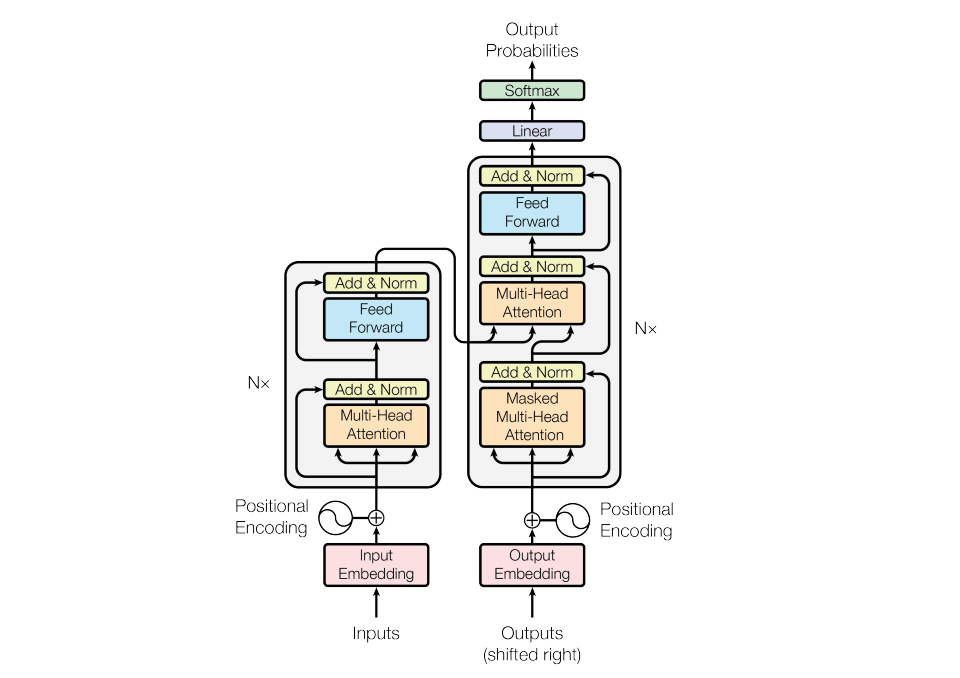
If you combine all of these techniques, you arrive at the most important neural network architecture of our time.
This is the backbone behind models like BERT, ChatGPT, and Qwen. Different flavors, different objectives … but the same core idea.
At this point, it's hard not to recognize one of the most famous diagrams in modern deep learning, which I'll take the liberty of sharing here.
Ladies and gentlemen… meet the Transformer.
So before we dive into LoRA or GRPO, remember this:
🙋 Understanding the structure we're working with is essential. That's exactly why we're taking the time to walk through these concepts!
This mental model will make every future lesson clearer, more intuitive, and far more effective!
The 3 Transformer architectures
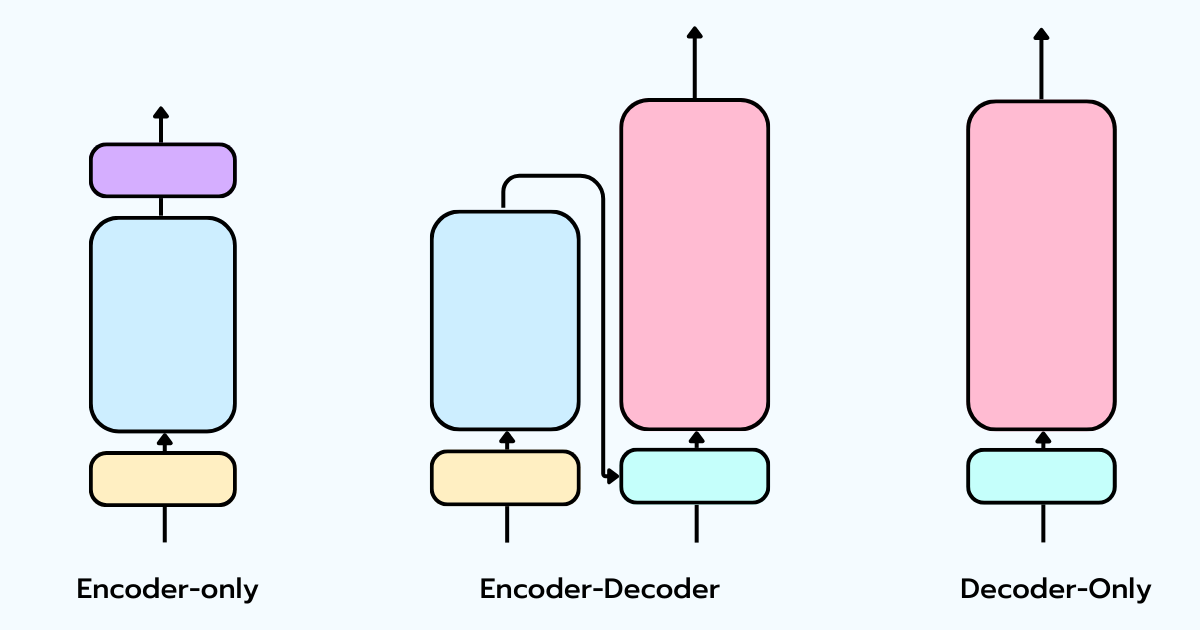
When people hear Large Language Models, many immediately think of systems like ChatGPT or Claude. That's understandable—but also a bit misleading.
⚠️ LLMs are not a single thing!
They come in three different Transformer architectures, each designed for different kinds of problems. Modern LLMs mostly rely on one of them—but the other two are just as important historically and practically.
Let's take a quick tour.
Encoder-Only Transformers
Encoder-only Transformers take an input sequence and turn it into rich representations, one per token.
All tokens attend to each other freely (bidirectional self-attention), which makes these models especially good at:
Understanding text
Classification
Retrieval
Semantic similarity
There's no text generation here—only encoding.
This family includes models like BERT, which popularized large-scale pretraining via masked language modeling. Encoder-only models shine when the goal is “understand this input” rather than “generate the next token.”
Encoder–Decoder Transformers
Encoder–decoder Transformers were the original Transformer design, created for sequence-to-sequence tasks like machine translation.
Here, the architecture is split into two parts:
The encoder reads and represents the input sequence
The decoder generates an output sequence, token by token
The decoder uses:
Cross-attention to look at the encoder outputs
Causal self-attention to avoid peeking at future tokens
This setup is ideal when:
Input and output are both sequences
Output length can vary freely
Models like T5 and BART belong to this family. They’re extremely flexible and powerful, especially for tasks like summarization, translation, and text-to-text learning.
Decoder-Only Transformers
Now we get to the architecture that powers modern LLMs.
Decoder-only Transformers remove the encoder entirely and rely on a single mechanism:
Causal self-attention over a growing sequence of tokens
Each token can only attend to tokens that came before it. The model is trained with a simple objective: predict the next token.
This design turns out to be shockingly powerful.
Almost every modern LLM follows this pattern. With enough data, parameters, and compute, decoder-only Transformers:
Learn language, reasoning, and structure
Perform tasks via prompting (in-context learning)
Scale remarkably well
🙋 This is the architecture we'll focus on for the rest of the course, because it's the foundation behind today's most capable LLMs
The Scaling Laws
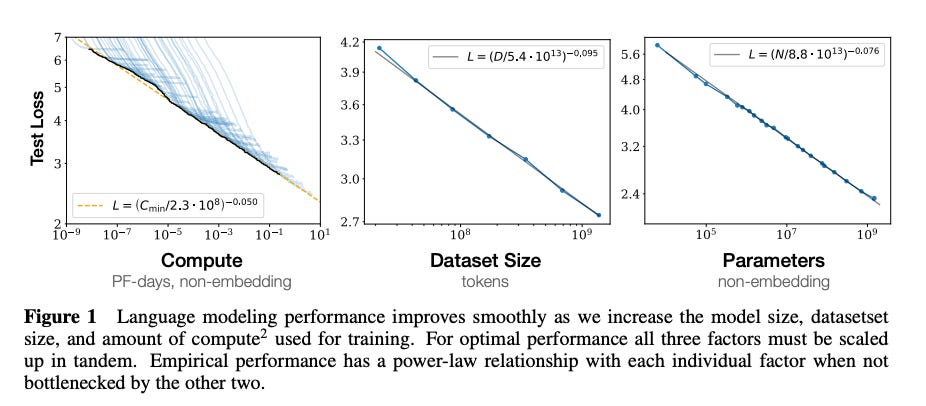
One last ingredient explains why Transformers became dominant: scaling.
Empirical studies have shown that Transformer performance improves smoothly as we increase:
Model size (parameters)
Training data (tokens)
Training compute
These improvements follow power-law scaling relationships, meaning that bigger models trained on more data tend to get predictably better—especially for language modeling.
Decoder-only architectures are particularly well-suited to this regime:
Simple objective
Massive unlabeled data
Efficient parallel training
This is why the biggest breakthroughs in recent years didn't come from radically new architectures—but from scaling Transformers to unprecedented sizes.
The LLM Training Pipeline
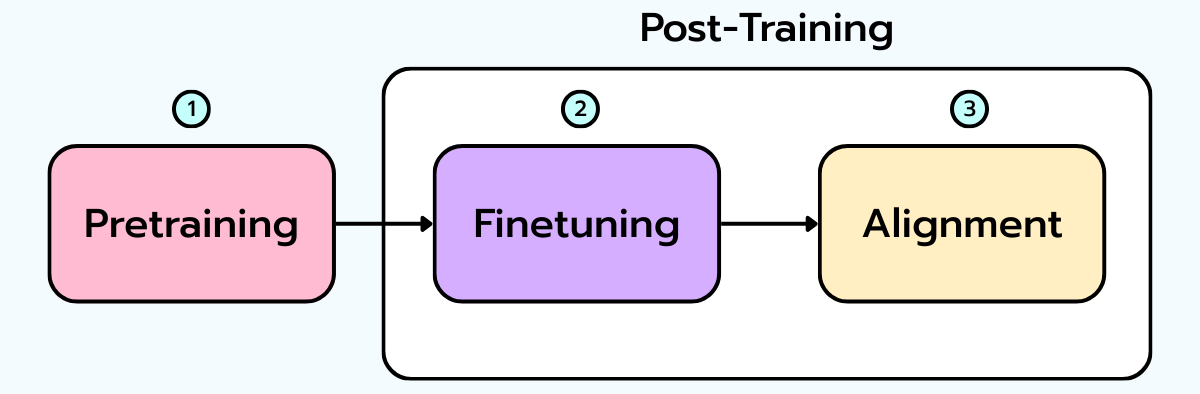
So far, we've talked about architectures. Now it's time to talk about how modern LLMs are actually trained.
When we refer to LLMs in this course, we'll be talking specifically about decoder-only language models—the family behind systems like ChatGPT, Claude, and Qwen. And while these models may look magical from the outside, their training follows a fairly well-defined pipeline.
🙋 That pipeline was clearly formalized in 2022 by OpenAI's InstructGPT.
Before InstructGPT, most language models were trained primarily as next-token predictors. They were good at completing text—but not necessarily good at following instructions, reasoning step by step, or aligning with human preferences.
InstructGPT marked a turning point. While it wasn't the first or the largest model of its time, it introduced and popularized a multi-stage training pipeline that has since become the standard for modern LLMs.
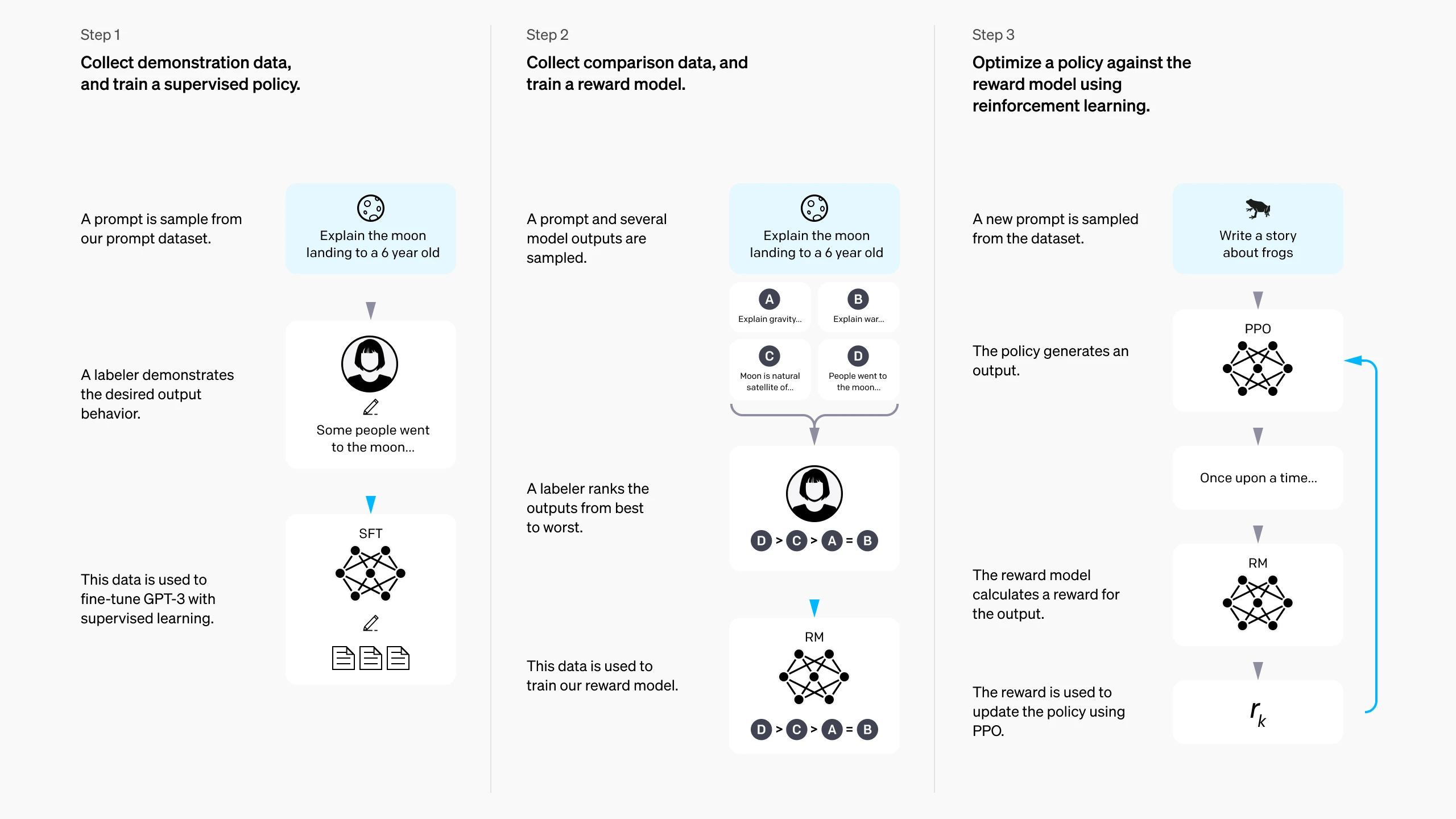
Concretely, it established a three-stage framework:
Pretraining on large-scale, raw text data
Supervised Fine-Tuning (SFT) on high-quality, task-oriented examples
Alignment via Reinforcement Learning from Human Feedback (RLHF)
This combination—pretraining + SFT + RLHF—proved far more effective than pretraining alone and laid the foundation for systems like ChatGPT and many successors.
As training methods evolved, people began describing this process in slightly different ways.
The three-stage view (pretraining → SFT → RLHF) is still widely used because of its historical and practical clarity.
A broader two-phase view is also common:
Pretraining, which builds general-purpose language capabilities
Post-training, which refines, adapts, and aligns those capabilities
Both perspectives describe roughly the same process. The difference is mostly conceptual.
If you want a great high-level walkthrough of this pipeline, we highly recommend the video below. It offers one of the best explanations available and complements this lesson beautifully!
👉 Watch the first 20 minutes, where Daniel Han covers the LLM Training Pipeline!
Pretraining 101
Now that we've mapped out the full LLM training pipeline, it's time to zoom in on the first—and most foundational—stage: pretraining.
Before models learn to follow instructions, answer questions, or behave nicely in a chat interface, they go through a much more fundamental phase. Pretraining is where a language model learns the basics of language itself—syntax, semantics, patterns, facts, and a surprising amount of what we often call world knowledge.
💸 It's also where the vast majority of a model's training compute and data are spent!
So what does pretraining actually look like?
What Happens During Pretraining
At its core, pretraining is simple.
A decoder-only Transformer is trained to predict the next token in a sequence, given all previous tokens. This is known as causal language modeling (CLM).
There are:
No instructions
No human feedback
No task-specific labels
Just raw text, one token at a time. Because pretraining uses the largest and most diverse dataset the model will ever see, this is the phase where it acquires:
Grammar and syntax
Style and structure
Facts and common sense
Code patterns
Multilingual capabilities (if trained on multilingual data)
🌎 This is why pretraining is often described as the phase where the model "learns the world."
Self-Supervised Learning
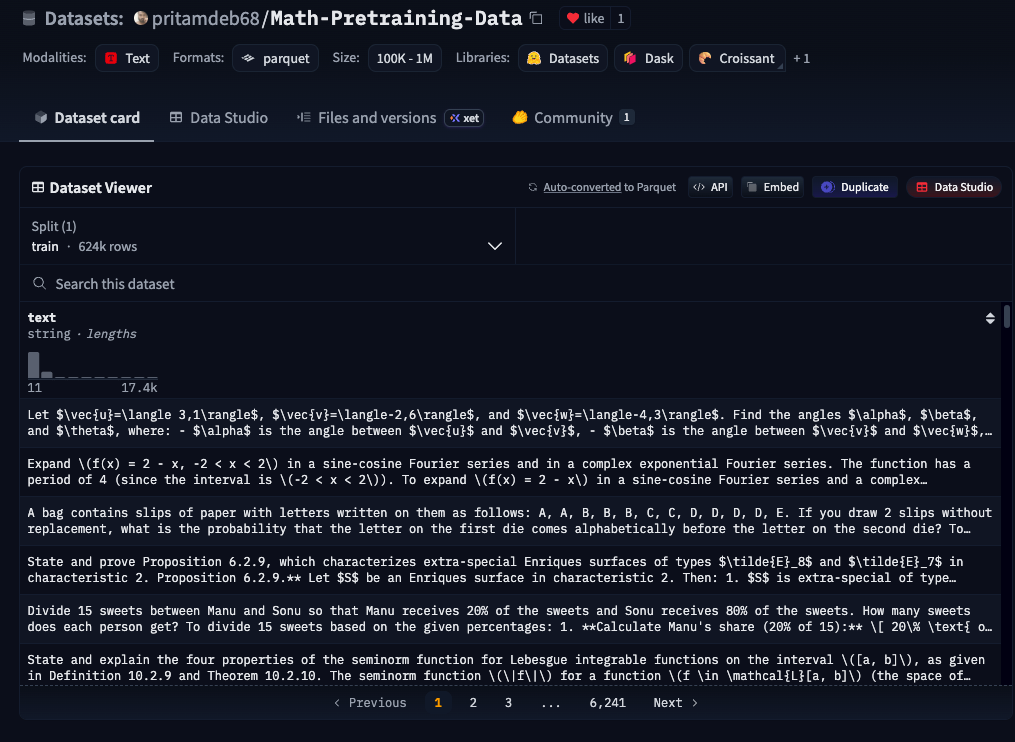
Pretraining does not rely on labeled data.
Instead, it uses self-supervised learning. The supervision signal is already present in the data itself: the next token is the label.
This is what makes pretraining scalable. The internet provides an enormous supply of raw text, and as long as you can tokenize it, you can train on it.
That's why most pretraining corpora consist largely of web pages, books, articles or repositories!
The output of pretraining: A Base Model
The result of pretraining is what we usually call a base model (or foundation model).
At this stage, the model is extremely good at continuing text. It has absorbed a broad distribution of language patterns, facts about the world, and even coding styles.
What it can’t do—at least not reliably—is follow instructions, decide when to refuse a request, or optimize for helpfulness or safety. None of that has been taught yet. The model has learned what language looks like, not how it should behave.
In other words, it’s powerful—but not yet usable as a product. This is where a famous analogy comes in.
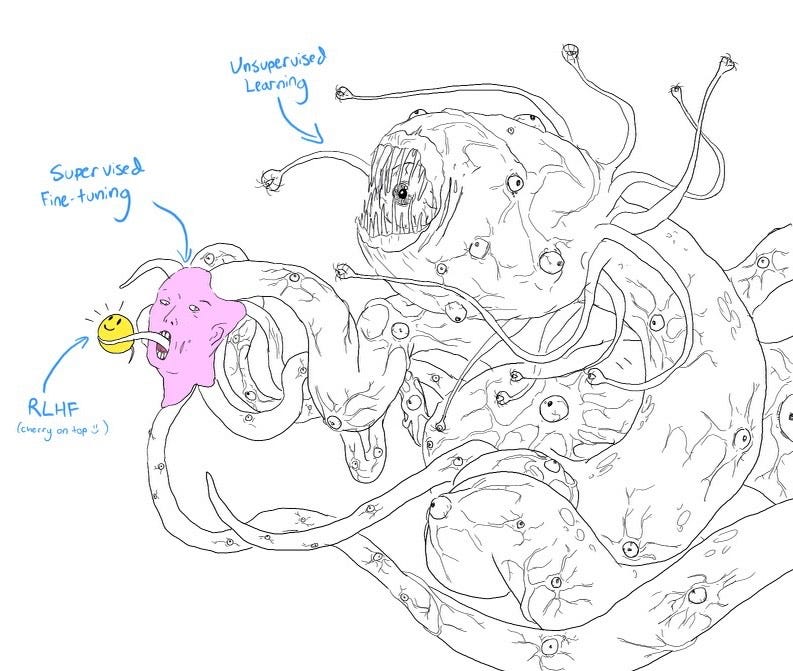
Chip Huyen's Shoggoth meme captures this stage perfectly. During pretraining, the model is essentially a raw pattern-learning engine—absorbing everything it sees, without judgment or alignment. The structure is there. The power is there. But the behavior is… unpredictable.
This is where everything that comes after pretraining enters the picture.
Techniques like Supervised Fine-Tuning (SFT), LoRA, and QLoRA are not about teaching the model language from scratch. Instead, they shape and steer the capabilities already learned during pretraining.
They teach the model how to respond to instructions, how to structure answers, and how to behave in ways that are consistent with human expectations—without rewriting everything it already knows.
In other words, pretraining builds the raw intelligence. Fine-tuning and alignment are what turn that raw intelligence into something usable.
🙋 And that's exactly where we're headed in the next lessons.
Next Steps
Now that you understand the theory behind pretraining, a very reasonable question might be:
When would I ever need to use this?
It’s not like most of us are sitting on a million-dollar budget to pretrain a model from scratch… right? 😄
The good news is that pretraining doesn't always mean starting from zero. In practice, there are very real scenarios where pretraining—or a variant of it—makes a lot of sense. For example:
When you want to add new domain knowledge, like legal or medical text
When you want to support an underrepresented language
When your data distribution is very different from what the original model saw
In these cases, continued pretraining can be a powerful tool. Instead of rebuilding a model from scratch, you extend an existing base model by exposing it to new data, allowing it to absorb new patterns and knowledge while retaining what it already knows.
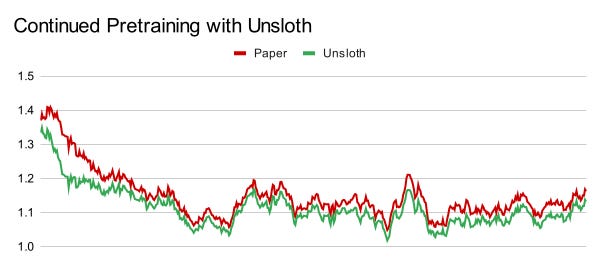
This is exactly what we'll cover in this Friday's lab, walking you through how to implement it step by step using our tech stack.
See you there!
References
Olah, C. (2015, August 27). Understanding LSTM Networks. Colah’s Blog.
Zhang, A., Lipton, Z. C., Li, M., & Smola, A. J. (2023). Dive into Deep Learning.
Morgan, A. (2025, August 1). Pretraining: Breaking Down the Modern LLM Training Pipeline. Comet Blog.
Kaplan, J., McCandlish, S., Henighan, T., Brown, T. B., Chess, B., Child, R., Gray, S., Radford, A., Wu, J., & Amodei, D. (2020). Scaling laws for neural language models. arXiv.
Vaswani, A., Shazeer, N., Parmar, N., Uszkoreit, J., Jones, L., Gomez, A. N., Kaiser, Ł., & Polosukhin, I. (2017). Attention is all you need. arXiv.
Huyen, C. (2023, May 2). RLHF: Reinforcement learning from human feedback. Chip Huyen Blog.
NVIDIA. (2023). AI scaling laws: What they are and why they matter. NVIDIA Blog.
OpenAI. (2022, January 27). Aligning language models to follow instructions. OpenAI.
Foundational articles are always hard because it’s not easy to know when to stop and move forward to the next subject. You struck a nice balance here and left enough crumbs for people to ask their LLM of choice about any gaps.
This clip lives rent-free in my head:
https://youtu.be/MO0r930Sn_8
Great introduction! Just starting the course, hoping and excited to learn a lot