


One of the most common sources of confusion in AI today is this:
👉 An LLM is not a product. It is a component.
A language model can generate text, reason, or write code—but by itself, it does not solve latency, safety, cost, or reliability.
Those problems don't show up in fancy demos… they show up the moment you move from a Jupyter notebook to a system that real users depend on!
In the excitement of generative AI, classical systems engineering has been widely overlooked. Yet the same concerns that govern distributed systems, databases, and high-traffic services come back with force: critical paths, performance budgets, failure modes, and trade-offs between speed, accuracy, and cost.
To help understand how AI systems are properly designed, this article focuses on one of the most common AI applications today: the chatbot.

🙋 Rather than treating it as a single model call, the goal is to look beyond the surface and decompose it the way an AI systems engineer would.
By breaking a chatbot down into its essential parts, it becomes possible to see what is actually required to build a modern AI assistant that can withstand the pressure, uncertainty, and trade-offs of real-world production environments.
Specifically, the system is deconstructed into three functional layers that are necessary for production-grade assistants:
Execution Layer
Control Layer
Evaluation Layer
The Execution Layer
This layer is responsible for executing model inference under real-world constraints: GPU memory, bandwidth, concurrency, and latency budgets.
It is the first point where classical systems engineering reasserts itself—because no amount of model capability can bypass physics.
At the center of this layer sits the inference engine.
➤ The inference engine
The inference engine is the runtime responsible for turning trained model weights into tokens streamed to users.
Unlike traditional web services—where performance is dominated by network hops, I/O waits, or database queries—LLM inference is dominated by memory movement. Modern GPUs can perform enormous amounts of compute, but they are constrained by how fast data can be read from and written to memory.
🙋 This is known as the memory wall.
Every active conversation allocates GPU memory to store its Key-Value (KV) cache, which represents the model's internal state across tokens.
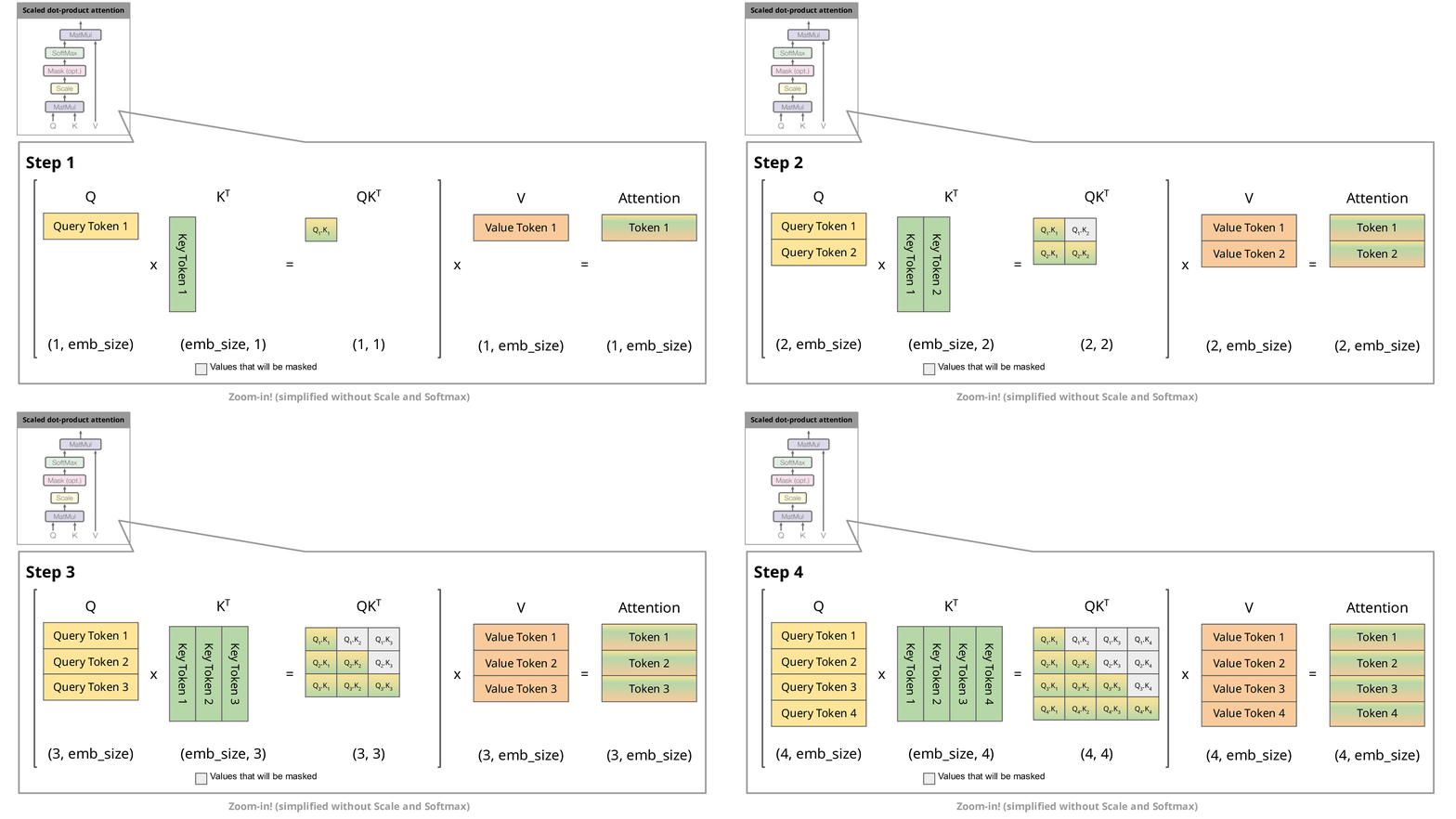
As conversations grow longer—or as reasoning models generate internal "thinking" tokens—the KV cache quickly becomes the dominant resource consumer.
This immediately introduces the central struggle of the Execution Layer: the latency–throughput trade-off.
